Open science has transformed neurotechnology research, giving even small teams access to powerful robust tools developed by the community. Early-career researchers and neuroscience enthusiasts entering EEG/MEG data analysis can benefit immensely from open-source software. These tools not only save costs but also foster collaboration and rapid innovation.
As a neuroscientist with nearly a decade of experience, I have worked with many of the leading open-source EEG and MEG analysis tools available in Python and MATLAB. In this article, I will offer a practical overview of the most widely used platforms, highlighting their key features, strengths, and limitations, to help newcomers navigate this rich and evolving ecosystem with confidence.
MNE-Python
- Platform: Python.
- Overview: MNE-Python is an open-source library and one of the most popular toolkits for EEG/MEG analysis in Python. It provides comprehensive capabilities for signal processing, visualization, and even source-level analysis of neurophysiological data (covering EEG, MEG, intracranial EEG/ECoG, fNIRS, etc.). Built on the scientific Python stack, MNE leverages libraries like NumPy and SciPy, and it’s collaboratively developed by a large community (more than 200 contributors).
- Advantages: Complete and well-documented pipeline. Its use of structured objects (like Raw, Epochs, Evoked) makes the workflow both fast and intuitive. You can easily inspect, modify, and process your data while keeping it well-organized. Leveraging the scientific Python ecosystem, MNE is optimized for performance and integrates seamlessly into data science workflows. Moreover it is modular and extensible: many smaller EEG/MEG-focused libraries (e.g., PyPREP, Autoreject, EELBRAIN) are designed to work with MNE objects, making it easy to build complex pipelines without reinventing the wheel.
- Limitations: Requires some Python scripting, so users unfamiliar with coding face a learning curve. However, the extensive tutorials and community support help flatten it.
- Go to MNE Website
EEGLAB
- Platform: MATLAB (with partial Octave support).
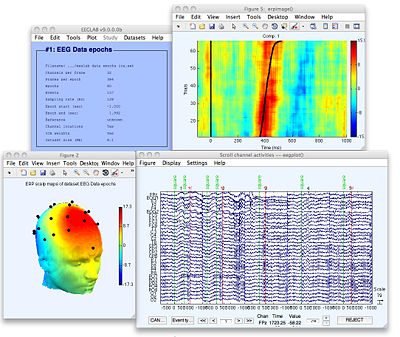
- Overview: EEGLAB is an interactive MATLAB toolbox for processing EEG (and MEG). It offers a user-friendly graphical interface to perform common EEG analyses such as filtering, artifact rejection, time-frequency transforms, and independent component analysis (ICA).
- Advantages: EEGLAB has been a go-to tool for two decades, boasting a large user base and plugin ecosystem. Its GUI lets beginners analyze high-density EEG data without writing code, and a plugin system allows community-contributed extensions (for example, specialized toolboxes for ERP analysis, connectivity, etc.). It also provides a command history and scripting interface to transition from GUI to automation as your programming skills advance. Perfect starting point for new researchers, but robust enough to support the needs of more advanced users.
- Limitations: Because it runs on MATLAB, a proprietary platform, users typically need a MATLAB license for full functionality. It can run on Octave (open-source MATLAB alternative) in text-mode, but the rich GUI is MATLAB-dependent. Thus, while EEGLAB itself is free and open-source, its reliance on MATLAB is a consideration for those without access to that software.
- Go to EEGLAB Website
FieldTrip
- Platform: MATLAB.
- Overview: FieldTrip is a powerful open-source MATLAB toolbox for MEG, EEG and iEEG data analysis. Geared towards research, it offers advanced methods including time-frequency analysis, multiple approaches to source reconstruction (e.g. dipole modeling, distributed source mapping, beamforming), and robust statistical tools for neuroscience. FieldTrip supports data from nearly all major EEG/MEG systems, which is great for collaborating across labs with different equipment.
- Advantages: Extremely flexible, it consists of modular functions that researchers can mix-and-match to build custom analysis pipelines in MATLAB. It’s actively maintained by a broad community (originating from the Donders Institute) and often serves as a reference implementation for new analysis techniques.
- Limitations: FieldTrip is code-driven, so users must be comfortable with MATLAB scripting to fully utilize it. This flexibility comes at the cost of a steeper learning curve for beginners compared to GUI-based tools. Additionally, as with EEGLAB, using FieldTrip requires a MATLAB environment (though the toolbox is free, MATLAB itself is commercial software), which can be a practical hurdle unless an open-source alternative like Octave is used (with potential feature limitations).
- Go to Fieldtrip Website
Note: Most universities provide researchers with access to a MATLAB license making it suitable for academia. By contrast, many companies are now shifting toward Python and fully open-source solutions to reduce costs, which can make MATLAB-based tools less accessible for developers in industry and freelancers.
Brainstorm

- Platform: Standalone application (developed in MATLAB/Java).
- Overview: Brainstorm is a collaborative open-source application dedicated to MEG/EEG and related brain signal analysis. It stands out for its easy, intuitive graphical interface that requires no programming knowledge. Brainstorm handles many data types (EEG, MEG, fNIRS, ECoG, etc.) and makes advanced techniques like source localization and connectivity analysis accessible through point-and-click workflows.
- Advantages: Ideal for clinicians and new researchers. You can visualize and process brain recordings step by step with an interactive pipeline. It emphasizes reproducibility; although coding isn’t required, users can script batch analyses for large datasets to ensure consistent processing. Importantly, Brainstorm does not require a MATLAB license to use, it’s available as a free standalone program on Windows, Mac, and Linux. This lowers barriers to entry while still offering the computational power of MATLAB under the hood.
- Limitations: Its GUI-centric approach means it may be less flexible for highly custom analyses compared to coding toolboxes (advanced users might still leverage MATLAB scripts for niche methods). However, for the vast majority of standard EEG/MEG workflows, Brainstorm’s comprehensive interface covers needs without coding.
- Go to Brainstorm Website
Embracing the Open-Source Ecosystem
The above tools exemplify the power of community-built software in neuroscience. Each has its niche: whether you prefer the interactive GUIs of EEGLAB or Brainstorm, or the scripting freedom of MNE-Python and FieldTrip, there’s an open-source solution to fit your workflow. This open ecosystem lowers barriers for early researchers to engage in EEG/MEG analysis and encourages sharing of methods and best practices.
At BrainAccess, we deeply appreciate this. Our platform allows data to be saved in multiple standard formats making it easy to import recordings into any of these open-source libraries for further analysis. Moreover, many of our own resources (e.g., our BrainAccess Board, mobile app, and SDK) are open source as well, reflecting our commitment to collaborative innovation. We rely on tools like MNE-Python in our development, and we’re grateful to the global community of developers and researchers who maintain these robust platforms.
By building on each other’s work, the neurotech community accelerates progress in understanding the brain, empowering neuroscientists and developers in their journey.
Written by Martina Berto, Research Engineer and Neuroscientist for BrainAccess at Neurotecnology.